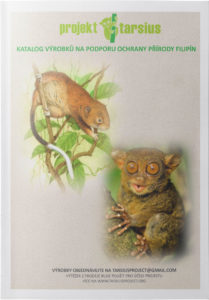
Research and conservation of the Philippine tarsier
Brief introduction of the project
In this project we focus on conservation of endangered primate species the Philippine tarsier (Tarsius syrichta) in-situ, i. e. in area of its origin. The Philippines belongs to biodiversity hotspots with high degree of threat, where conservation efforts should be concentrated. The Philippine tarsier is threatened especially due to habitat loss in the Philippines but also due to direct human threat 1,2, 5.
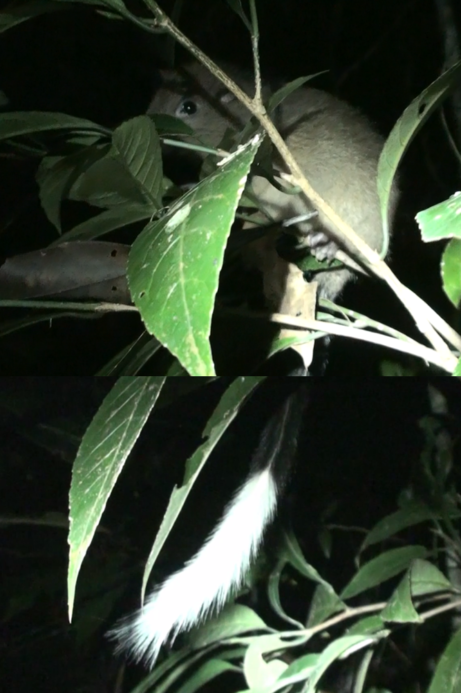
Goal of this project is integration of conservation activities, education and research, which will help to gain lacking information about this interesting and still little studied species. In-situ project is conducted on Bohol island (first fieldwork period was conducted in 2009, another is being conducted since January 2010), where we observe the tarsiers using radio-telemetry and extend the conservation activities. Educational work is done in cooperation with our local partners. Local people as well as local and foreign visitors of Bohol are the target group, we focus especially on school children which has greatest impact on future survival of tarsiers and other Philippine species. As a part of the project we organize presentations about tarsiers and other Philippine species in Czech Republic.
Goals of the project
Goal of the project is to help conservation of the Philippine tarsier (Tarsius syrichta) in-situ, i. e. in their area of original distribution. The project has several parts. We would like to integrate extension of conservation activities, education and scientific research, which will help to gain lacking informations about this interesting and endangered species.
1. Research of tarsier behaviour
Only few studies have dealt with the Philippine tarsiers 3,4,6,7. In comparison with Indonesian tarsier species we have very little knowledge about this species. As a part of the study we study biology of the tarsiers using radio-telemetry. Our study will be conducted during two years period and will provide important data about social behaviour, communication, reproduction and home-ranges that will not only extent information about this small nocturnal primate but also have impact on its conservation. During our Philippine fieldwork we will intensify the cooperation with local researchers and university students that has already started.
2. Educational work in the Philippines
In our project we focus on extension of educational activities of our local partners. Local and foreign visitors are the target group, we focus especially on school children which has greatest impact on future survival of tarsiers and other Philippine species. We conduct monitoring of tarsier populations and to promote sustainable tarsier ecoturism.
Goals are:
- training of local workers and young conservationists that will be involved in tarsier conservation and education for public and schools
- produce of informative posters in local and English language for visitou in tarsier habitat areas
- organization of presentations and preparation of education materials in local language for public community and schools
- produce of promotional leaflets in local and English language for local and foreigner visitors.
- monitoring of areas with tarsier populations
- promotion of ecoturism
3. Information of Czech people about the Philippine tarsier and ongoing activities
As a part of the project we will organize following activities focused on the Philippine tarsier and other endangered Philippine species
- publishing informations about ongoing activities, photos and video and audio-records on our web page
- presentations
- publication
- produce of promotional leaflets
- produce and sale of promotional articles (posters, postcards, T-shirts etc.) that will help to emphasize necessity of tarsier and habitat conservation and help to gain additional funds.
Schedule and locality
Before the project started
The idea of realization of presented project started in 2007. In January 2007 went two Czech zoologists RNDr. Milada Petrů (Decin Zoo, Charles University) and Richard Policht, MSc. (Charles University) two months expedition to the Philippines.
Study of acoustic communication of endemic bird species, monitoring of ongoing local conservation project and possibilities of further zoological research were the main goals of the journey. During the stay in the Philippines we had opportunity to visit several interesting places on Luzon, Palawan, Cebu, Bohol, Negros and Panay islands and get acquainted with local conditions. We visited several conservation organizations and universities and get acquainted with ongoing or planned research and conservation projects. We had chance to contact several local experts.
The idea to get involved in tarsier conservation occurred long before visit of Bohol and was supported after visit of the Corella locality and also Loboc.
During the stay in 2007 in the Philippines we collected and analyzed valuable data about vocalization of endemic bird species of hornbills. Results have been presented on several scientific conferences and published 8.
2009
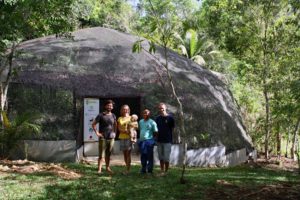
The first fieldwork period of the Tarsius project was conducted between March and July 2009, when we radio-tracked three males and two females and informed you about the project progress on our website. First research period was conducted in the Philippine Tarsier and Wildlife Sanctuary near Corella in southwest part of the Bohol island.
During stay in Czech Republic we analyse the data and prepare it for publication and presentations and we continue in activities for Czech public.
2010
The next fieldwork is being conducted since January 2010 this time in Bilar area. We are interested in comparison of results got from Corella and here in Bilar where no similar study has been done and we continue with conservation education activities, especially important in this area.
But we are interested also in populations living on other islands, like Dinagat island.
News from the field can be found on our web site.
References
1 Aure B. & Escabi C. 2005. Tarsier talk: Tarsiers, hunters, and ecoturism in Corella, Bohol. Philippine Qurterly of Culture and Society. 33, 76-99.
2 Caňete A. 2003. How does species endangerment begin? Tarsier Conservation, eco-tourism and farmers in two towns in the province of Bohol, Philippines. Philippine Qurterly of Culture and Society. 31, 182-206
3 Dagosto, M. & Gebo, D.L. 1997. A preliminary study of the Philippine tarsier (Tarsius syrichta) in Leyte. American journal of physical anthropology 73.
4 Dagosto, M., Gebo, D.L. & Dolino, C. 2001. Positional behavior and social organization of the Philippine tarsier (Tarsius syrichta). Primates 42, 233-243.
5 Arboleda, I. 2008. Tarsius syrichta. In: IUCN 2008. 2008 IUCN Red List of Threatened Species.
6 Jachowski, D.S. & Pizzaras, C. 2005. Introducing an innovative semi-captive environment for the Philippine tarsier (Tarsius syrichta). Zoo Biology 24, 101-109.
7 Neri-Arboleda, I., Stott, P. & Arboleda, N.P. 2002. Home ranges, spatial movements and habitat associations of the Philippine tarsier (Tarsius syrichta) in Corella, Bohol. Journal of Zoology 257, 387-402.
8 Policht R., Petrů M., Lastimoza L. and Suarez L. (2008) Potential for the use of vocal individuality as a conservation research tool in two threatened Philippine hornbill species, the Visayan Hornbill and the Rufous-headed Hornbill. Bird Conservation International, 19, 83-97.